Collective Thinking: Lessons from the Noosphere Lab
What happened when thirty anonymous participants tried to write a story and a discussion paper together—in real time, without a leader or plan.

We tend to imagine thinking as something that happens inside an individual mind.
A person encounters a problem, recalls relevant knowledge, explores possible solutions, combines ideas, and eventually reaches a conclusion. Intelligence, on this view, is the capacity of an autonomous individual to solve problems.
Yet many of the most impressive achievements of intelligence are not the product of any individual mind. No single person created science, mathematics, language, Wikipedia, the Internet, or modern technology. These systems emerged from the contributions of countless individuals, each building on what others had done before.
This raises a fundamental question: can a collective think? And if so, what makes collective thought intelligent rather than confused, conformist, or chaotic?
These questions motivated the Noosphere Lab, a public experiment in collective thinking organized by the Center Leo Apostel’s School of Thinking at the Vrije Universiteit Brussel, in collaboration with our partners at Human Energy.
The event combined theoretical presentations with two practical experiments in which around thirty participants, online and on-site, simultaneously edited the same shared Google document.
What happened offered some intriguing first clues about both the power and the limitations of collective intelligence.
Intelligence is already collective
The idea that intelligence is distributed is not limited to social groups.
Even the human brain does not appear to contain a single controller, executive, or inner observer directing all thought. Instead, cognition emerges from the interaction of many specialized processes. Marvin Minsky famously described this as a society of mind. Different agents perform different functions, and what we experience as coherent thought emerges from their collaborative activity.
Something similar happens at the social level. Individual people possess different forms of knowledge, experience, perception, imagination, and skill. By combining these complementary capacities, a group may be able to solve problems that none of its members could solve alone.
That is how we can define collective intelligence: the capacity of a collective to develop better solutions, deeper insights, or more complex designs than its individual members could produce separately.
Examples are found throughout nature and society:
ant colonies collectively discover efficient routes to food;
termite colonies construct elaborate nests;
firms coordinate specialized work;
markets aggregate dispersed information;
scientific communities progressively develop theories;
Wikipedia integrates the contributions of millions of editors.
But collectives are not automatically smarter. Groups can also be less intelligent than their members, something we might call collective stupidity.
That happens when they converge prematurely on bad ideas, suppress dissent, ignore relevant information, defer to authority, or amplify an initial error until it becomes dominant. This is the familiar phenomenon of groupthink that also underlies polarization.
Collective intelligence therefore depends not merely on bringing people together, but on organizing their interaction in the right way.
Four requirements for collective intelligence
In The Wisdom of Crowds, James Surowiecki proposed four conditions that help a collective outperform its individual members:
Diversity: participants should bring different perspectives and forms of expertise.
Decentralization: they should be able to work independently and in parallel.
Independence: they should not simply imitate or conform to one another.
Aggregation: their separate contributions must somehow be integrated into a common result.
The most common way of making collective decisions, meetings in which people express their opinion and discuss options, lack most of these conditions. Participants are not working in parallel or independently and are directly influenced by what was said before. Moreover, there is no obvious way to make sure all points of view are aggregated. That is why group discussions of even highly expert individuals may degenerate in groupthink—as many historical examples of bad decisions testify.
That is why we need better methods of collective thinking. However, a method that satisfies all four conditions is not obvious, because there is an inherent tension:
Independence preserves diversity, but too much independence produces fragmentation and lack of coordination.
Aggregation creates coherence, but tends to erase differences.
Too much pressure toward coherence produces conformity.
The challenge is to integrate individual contributions without suppressing their diversity.
A method that appears especially well suited to this task is stigmergy.
Stigmergy: coordination through traces
Stigmergy is a form of indirect coordination through a shared environment.
The basic mechanism is simple:
an agent performs an action;
the action leaves a trace in a shared medium or environment;
that trace stimulates another action, by the same or a different agent;
the new action modifies the trace;
the cycle continues.
That allows a collective of simple agents to build complex solutions by relying on the shared trace to coordinate their work.
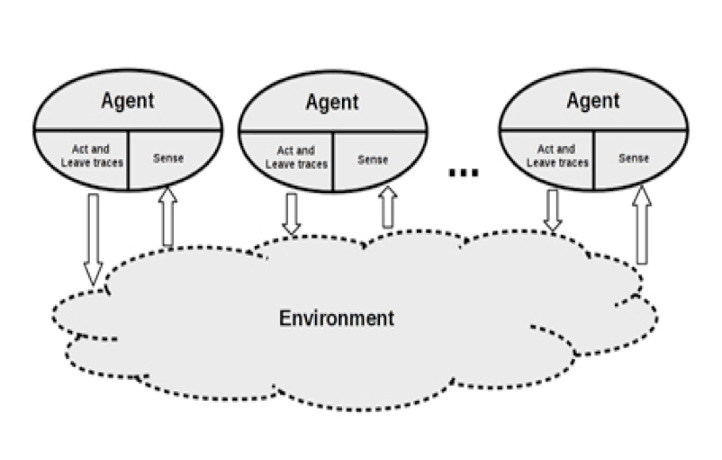
The term was originally introduced to explain how social insects coordinate their activities without any central controller. A termite deposits a small amount of mud. Other termites are more likely to add mud where some is already present. This positive feedback gradually produces columns and arches, eventually resulting in an intricate nest that no termite has designed or even understands.
Ants use pheromone trails in a similar manner. An ant that finds food leaves a chemical trace on its way back to the nest. Other ants tend to follow the stronger trails, reinforcing routes that successfully lead to food. Trails to exhausted food sources gradually evaporate. The colony thereby develops an adaptive network of paths.
No ant possesses a map of the environment. The map is produced outside the ants, embodied in the pheromone trace. Thus, the trace functions as a shared external memory that each ant can use and update.

That may be the most important feature of stigmergy. The trace remembers what previous agents have done. New agents can continue the process without needing to know who came before them, what they intended, or what the final result is supposed to become. The trace functions like a distributed cognitive system that guides the agents in their further activities, while becoming ever more detailed and accurate as it is being used.
Human stigmergy
Humans coordinate in similar ways.
A scientist publishes an article. Other researchers confirm, criticize, extend, or reinterpret it, adding their results to the repository of publications.
A programmer adds code to an open-source project available on a shared website. Others improve or replace it.
Someone edits a Wikipedia page. Later contributors correct mistakes, add references, reorganize sections, or clarify arguments.
In each case, the developing trace (publication record) guides further work. The trace typically aggregates the result of previous work, for example: a theory, a piece of code, or a paragraph of text.
However, the trace may also specify the work that needs to be done, for example: an open question, a bug description, or a list of issues that still need to be addressed. This can be facilitated by specific markers indicating what still needs to be done. For example, a text being written may contain the following markers:
[clarify]
[reference needed]
[add example]
[counterargument?]
[reorganize this section]
These meta-marks function rather like pheromone signals. They attract attention to unfinished work and stimulate appropriate action.
Stigmergy supports collective intelligence because it satisfies Surowiecki’s four requirements rather naturally:
It supports decentralization, because many people can work in parallel.
It preserves a degree of independence, because contributors can act anonymously on different parts of the trace and do not need to defer to authority or majority opinion.
It mobilizes diversity, because different people can work on different tasks that match their own interests and expertise.
And it enables aggregation, because all contributions accumulate in the same persistent trace.
Standing on the Shoulders of Giants
Science is perhaps humanity’s clearest example of stigmergic collective intelligence. As Newton famously put it, researchers advance by “standing on the shoulders of giants”: each new theory builds on work produced by others.
But this cumulative process is possible only because ideas leave persistent traces in shared media—books, journals, preprints, diagrams, photographs, databases, and now digital repositories. Once published, an idea can be corrected, confirmed, challenged, or elaborated by researchers working independently and in parallel. Their contributions are gradually integrated into reviews, textbooks, and broader theoretical frameworks.
No final authority decides what is true; scientific knowledge self-organizes through the continual interaction of many partial contributions.
Why discussion is not enough
Most attempts at collective thinking rely on meetings and discussion.
But conversation has serious limitations. It is:
sequential: only one person can speak at a time.
transient: spoken contributions disappear unless someone records them.
socially constrained: people hesitate to contradict authorities, interrupt dominant speakers, or express unconventional ideas.
path-dependent: an early remark may steer the entire discussion in one direction before alternatives have been explored.
Stigmergic collaboration avoids many of these constraints.
parallel: Several people can contribute simultaneously.
persistent: The results remain visible and cumulative.
independent: Participants can respond to the content rather than to the status of the person who produced it.
the shared document functions as a collective working memory that everyone can inspect and modify.
This does not mean that stigmergy eliminates all problems. A shared document can become chaotic, repetitive, contradictory, or overloaded. But it creates a different space of possibilities from ordinary conversation.
The Noosphere Lab was designed to explore those possibilities directly.
Compressing years into one hour
Science, Wikipedia, and open-source software are stigmergic systems, but they develop slowly. Contributors contribute asynchronously, accumulating results over months, years, or centuries.
The Noosphere Lab tested something more unusual:
Can stigmergic collective thinking self-organize in real time?
Around thirty participants were simultaneously editing the same Google Doc, as anonymous contributors. There was no leader, no assignment of tasks, and no restriction on what anyone could do.
Participants could:
add text;
edit text written by others;
move sections;
delete passages;
introduce new ideas;
correct language;
add meta-marks;
reorganize the emerging whole.
Apart from some some broad guidelines functioning as suggested ways of contributing, the process was left to self-organize through the developing trace.
We performed two experiments.
Experiment 1: writing a story from nothing
The first group was asked to write a story.
There was no predefined setting, theme, genre, character, or plot. The only requirement was that the result should become interesting to read.
This made the experiment strongly emergent. Rather than collectively executing a plan, the participants had to discover the story while writing it.
Fragments appeared in different parts of the document. Characters were introduced, altered, or abandoned. Plot elements developed in parallel. Some contributions reinforced one another; others pulled the story in different directions.
For participants, the process was sometimes disconcerting. So many pieces of text were appearing and changing simultaneously that it became difficult to maintain an overview of the evolving narrative. The document seemed to oscillate between order and chaos.
Yet participants also began correcting and integrating one another’s work. They removed inconsistencies, developed promising motifs, connected fragments, clarified characters, and tried to give the emerging sequence some continuity.
The resulting story, The Museum of Unfinished, did not originate in any individual imagination. Its plot and atmosphere emerged from the interaction of many partially independent contributions.
Whether the result is genuinely engaging is something readers can judge for themselves.
Experiment 2: collective reflection
The second experiment asked participants to develop a discussion paper about:
The power of stigmergy for collective thinking.
The idea was that they would collect and organize the different ideas and questions they had developed while preparing for the experiment. This process appeared easier. Unlike a story, an analytical discussion can be divided into relatively independent themes:
definitions;
examples;
advantages;
limitations;
open questions;
possible applications;
comparisons with discussion;
relations with AI and the noosphere.
Participants could therefore focus on sections that matched their interests or expertise. This spontaneous division of labor is itself a central advantage of stigmergy. Nobody assigned participants to topics. They selected the material that attracted their attention and contributed where they felt they could add something.
The resulting document contains many interesting ideas, observations, questions, and hypotheses. It also contains the predictable defects of a rapidly produced collective draft: repetitions, gaps, shifts in terminology, inconsistent levels of detail, and unresolved tensions.
But these defects are not necessarily failures. They are traces indicating where further work is required.
Provisional lessons
Several preliminary conclusions emerged.
1. Collective writing is easier when the task is modular
The discussion paper naturally divided into sections. The story required tighter temporal and causal integration.
This suggests that stigmergic collaboration works especially well when the overall task can be decomposed into partially independent components.
2. Editing is at least as important as adding
Participants tend initially to think that contributing means writing something new.
But collective coherence depends just as much on:
correcting;
shortening;
connecting;
restructuring;
removing;
rewriting.
A stigmergic system needs both constructive and selective processes.
Without additions, nothing emerges. Without correction and deletion, disorder accumulates.
3. Anonymity reduces social inhibition
Because most editors were anonymous, participants did not know whose text they were modifying.
This reduced the temptation to defer to prestige, protect personal ownership, or avoid changing another person’s contribution out of politeness. Attention shifted from authorship to the quality of the collective result.
4. The trace becomes the center of coordination
Participants did not need to know who was doing what. They responded to what appeared in the document.
The evolving text itself organized attention, suggested tasks, preserved earlier work, and invited further contributions. The document was not merely recording thought. It became part of the thinking process.
From synchronous to asynchronous stigmergy
The one-hour experiment was deliberately extreme: just one hour to write a story or a discussion paper, with thirty people editing simultaneously.
Normally, stigmergy is asynchronous. Contributors are active at different times. They inspect the trace, reflect, act, and leave. The evolving structure remains available for later participants. This temporal flexibility is one of the main reasons stigmergy scales so effectively.
Wikipedia does not require all editors to be present at once. Science does not require all researchers to work simultaneously. It is the persistent trace that connects people across time.
We therefore preserved the documents as linked above exactly as they appeared at the end of the synchronous sessions. These frozen versions provide a snapshot of what around thirty anonymous participants could produce within one hour.
But now we also created follow-up versions that remain open for editing. This initiates a second phase of the experiment: slow, asynchronous stigmergy.
Participants—and now other interested contributors—can return whenever they wish. They have time to read carefully, reconsider, reorganize, correct, and refine. Therefore, we invite all readers of this post to participate in the continuation of the experiment.
The follow-up documents are available for contributing and editing here:
The Museum of Unfinished: story
Collective Thinking via Stigmergy: discussion paper
The aim is not primarily to add more text or ideas: there is already plenty of material. It is to collectively improve what is already there.
Small changes may be especially valuable: correcting a sentence, removing a redundancy, connecting two ideas, moving a section to a different place, resolving a contradiction, tightening the plot, or adding a missing reference. Many local improvements may gradually produce a much more coherent global result.
These documents will remain available for editing until at least October, when we will start writing up the results of the experiment. Our goal is to publish both the theoretical framework and our observations in a paper for a special issue on stigmergy in the interdisciplinary research journal Interface Focus.
What does time contribute?
This continuation of the experiment gives us an opportunity to compare two forms of collective thinking: synchronous vs. asynchronous.
The original, frozen documents show what can emerge under conditions of:
simultaneous presence;
anonymity;
time pressure;
high activity;
limited reflection.
The evolving, follow-up documents will show what emerges through:
slower reflection;
repeated revision;
longer-term memory;
cumulative selection.
This comparison may help us understand the role of time in stigmergic intelligence.
Does simultaneity stimulate creativity but reduce coherence?
Does slower interaction improve integration?
Does a collective document converge toward a stable form?
Or does it continue generating new branches, questions, and alternatives?
Can we learn to think together better?
The question is not whether collective thinking exists.
Humanity has always thought collectively. Language, culture, science, technology, and the noosphere itself are products of distributed cognition. The more important question is whether we can design environments that make collective thought more intelligent.
Can we preserve diversity without fragmentation?
Can we aggregate contributions without imposing conformity?
Can we encourage creativity while still producing coherence?
Can digital media help us avoid the limitations of meetings, hierarchies, and social pressure?
And can humans increasingly collaborate not only with one another, but also with AI systems, within shared stigmergic environments?
The Noosphere Lab offered only a first experiment. But it made one thing immediately visible:
When people contribute to a shared and persistent trace, thinking no longer belongs exclusively to any one of them.
It begins to happen between them.
Further reading
Heylighen, F. (2026). Stigmergy: The most important concept you’ve never heard of [Substack].
Heylighen, F. (2016). Stigmergy as a universal coordination mechanism I: Definition and components. Cognitive Systems Research, 38, 4–13. https://doi.org/10.1016/j.cogsys.2015.12.002
Heylighen, F. (2007). Why is Open Access Development so Successful? Stigmergic organization and the economics of information. In Bernd Lutterbeck, Matthias Bärwolff, & Robert A. Gehring (Eds.), Open Source Jahrbuch 2007 (pp. 165–180). Lehmanns Media.
Your articulation of stigmergy as a distributed cognitive process is striking. The way you frame the trace as both memory and signal — something that guides agents without any of them needing the whole map — clarifies how collective coherence can emerge without central control. The pheromone‑like meta‑marks in human collaboration make the mechanism visible in a way most people never notice. It’s a powerful explanation of how thinking can happen between individuals rather than inside any one of them.